
SyMAP has been updated for the GLOBE final rule. Pricing teams can now model potential Medicare Part B rebates alongside international pricing, launch plans and global revenue.
Under GLOBE, international pricing and launch decisions can change a product’s US rebate exposure. SyMAP’s updated model helps teams quantify that exposure, test alternative plans and compare the effects on global revenue.
Our recent GLOBE analysis explains the policy changes and their implications for global pricing.
Watch the GLOBE model in action
Follow a fictional product through a GLOBE assessment, a comparison with GENEROUS and a launch planning exercise. The walkthrough also tests a hypothetical extension beyond GLOBE’s initial period.
Read the written walkthrough
The recording uses the fictional product Ombrevia. The figures are illustrative and depend on the assumptions shown.
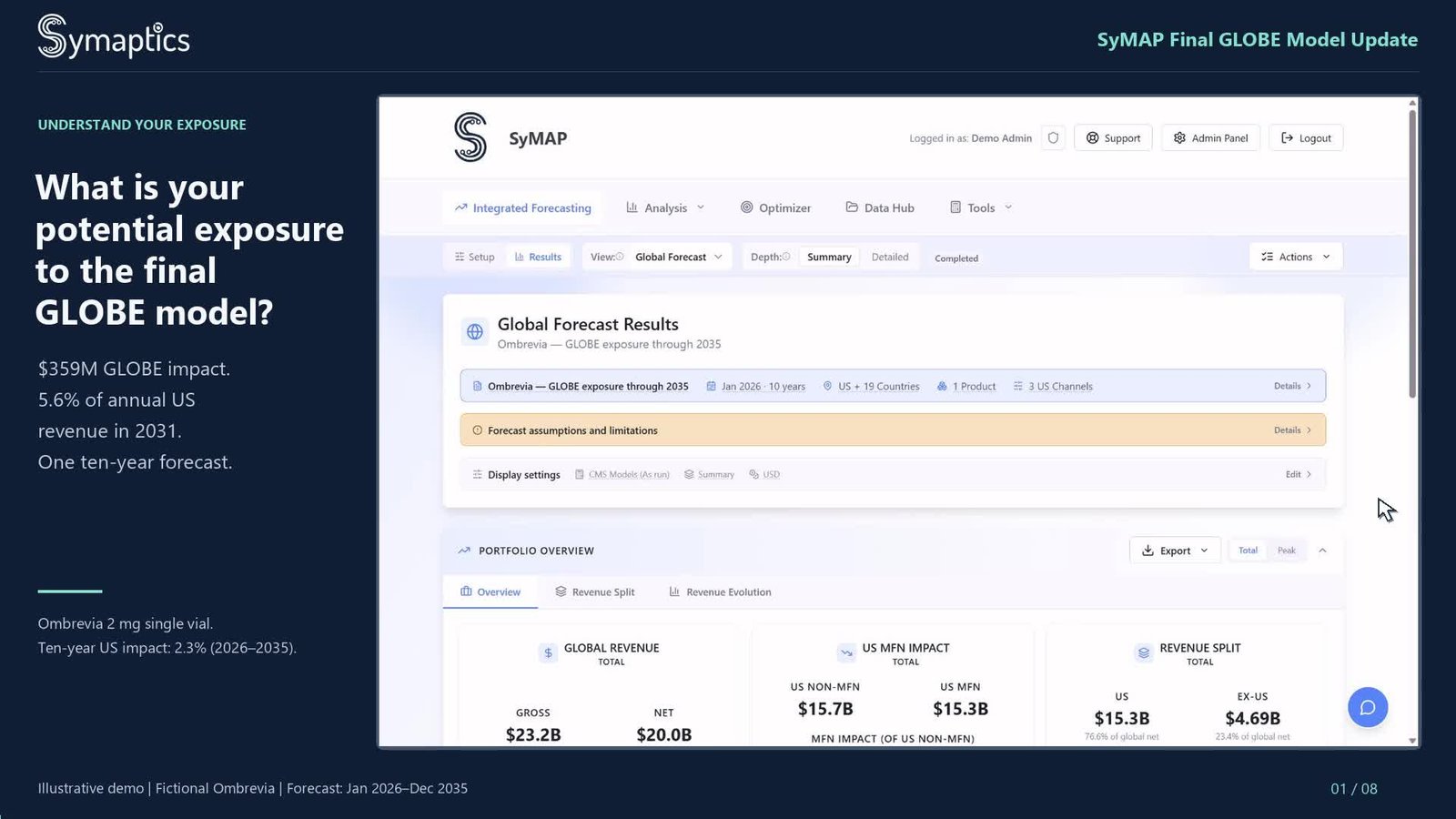
- Potential exposure. The opening forecast shows approximately $359 million of GLOBE impact across a 2026 to 2035 forecast, with an annual US revenue impact of 5.6% in 2031. The ten-year US impact is 2.3%.
- Set up and inspect the analysis. The user enables IRP, MFN and Global Revenue, selects GLOBE and runs the simulation. The results show the price gap, revenue effect and the Method I and Method II benchmark detail.
- Compare participation assumptions. The displayed comparison uses a GENEROUS-through-2030 baseline and an assumed earlier exit after 2028. It shows $93.7 million of GENEROUS rebates avoided and $176.3 million of additional GLOBE rebates: a net modelled cost of $82.6 million. Agreement terms, continuing obligations and access effects need to be assessed separately.
- Test an extension. A separate sensitivity extends GLOBE by four years and increases coverage from 25% in the original period to 50% in the extension. The forecast runs through 2035 and shows $1.35 billion of total modelled GLOBE impact. This is a hypothetical planning case, not the final rule’s adopted duration or coverage.
- Explore launch timing. An optimisation study using the extension scenario compares launch dates across five markets. The best plan found within the tested bounds shows $278 million more net revenue through 2035, including $78.4 million in the US and $200 million outside it. These are illustrative simulation results, not a guarantee of savings.
What has changed in SyMAP
The update incorporates the final rule’s timing, international benchmark methods and rebate calculations. Teams can select the drugs to assess, set entry and exit assumptions, and inspect the prices and adjustments behind each result.
The assessment uses Method I and quarterly Method II benchmarks, including the final rule’s GDP purchasing-power adjustments. Results show both the total GLOBE rebate and the additional amount above the Part B inflation rebate, alongside the effect on forecast revenue.
Compare global pricing and launch plans
Compare alternative prices and launch dates across markets, and examine their effect on GLOBE rebates, international reference pricing and global revenue. This helps teams weigh a reduction in US rebates against any revenue lost elsewhere.
Test a potential extension of GLOBE
Commercial plans may run well beyond GLOBE’s initial period. SyMAP also lets teams model a potential extension, choose its duration and coverage assumptions, and compare the results with a scenario that ends as scheduled.
That comparison shows how additional years of rebate exposure could affect cumulative revenue and the choice of pricing or launch strategy. Any extension is a hypothetical planning scenario, with assumptions set by the team.
Model your GLOBE exposure after GENEROUS
GENEROUS is scheduled to end on 31 December 2030. GLOBE’s performance period runs to 31 March 2032, leaving a further 15 months to consider in a long-term forecast.
CMS intends to waive mandatory GLOBE participation for manufacturers during quarters in which they participate in GENEROUS. Exposure afterwards will depend on the relevant waiver and participation terms, and any subsequent CMS changes.
In SyMAP, teams can set the assumed start of GLOBE exposure and estimate rebates through the remaining period. Changing international prices, launch dates or volumes shows which products are most sensitive to the commercial plan.
Assess the trade-off if withdrawal is an option
The earlier article considered whether a permitted withdrawal from GENEROUS could make financial sense. GLOBE’s narrower product scope means the answer may differ substantially between portfolios.
The comparison needs to cover the GENEROUS commitments that would actually cease, any additional GLOBE rebates, obligations that would continue, and access or other benefits that could be lost. A manufacturer with substantial GENEROUS commitments and limited GLOBE exposure may reach a different conclusion from one with a large eligible Part B portfolio.
Use SyMAP to compare the rebate and revenue effects of the options available under your agreements and assess the financial trade-off across your portfolio.1
See what GLOBE could cost your portfolio
See how different prices, launch dates and a hypothetical extension could affect your portfolio’s rebates and global revenue. Book a SyMAP demo focused on the decisions your team needs to make.