Pharmaceutical Pricing Analysis & IRP Consulting

You bring the pricing question. We build it in SyMAP, run the analysis, and give you an answer you can put in front of a board. You keep the model.

Two ways to work with us

Symaptics offers pharmaceutical pricing analysis as a service, and SyMAP as software. Most pricing questions do not arrive with a software procurement cycle attached. A board asks what a voluntary MFN agreement would cost, or whether an acquisition target’s pricing holds up, and the answer is needed in weeks. So there are two routes into the same models.

We run it for you

You describe the decision. We scope it, build the model in SyMAP, run the scenarios, and deliver the analysis with a strategic read of what it means. You get the deck, the interpretation and native access to the app to explore the results yourself.

Best when the question is urgent, one-off, or needs an outside view that will stand up to scrutiny.

Discuss a project

You run it in-house

Licence SyMAP and your own team builds and runs the models: international reference pricing simulation, all four US Most Favored Nation pathways, revenue and patient forecasting, and launch optimisation, with AI that explains every result.

Best when pricing questions are continuous rather than occasional and you want the capability inside the team.

Explore the platform

The analysis is run by the same small team that built the platform, so you are not handed to a delivery layer that has never opened the model. Who we are. These are not alternatives so much as a sequence. Most pharmaceutical pricing clients start with a project because it answers something specific, then licence the platform once they can see what having it in-house is worth. Nothing is wasted in that transition, which is the point of the next section but one.

How a project runs

1. Scope the question
A conversation about the decision you actually have to make, what would change your mind, and when you need it. We agree the markets, the products and the scenarios worth running before any modelling starts.
2. Build it in SyMAP
Your portfolio, your markets, real country rules and reference baskets, correct assessment timing and FX. Built in the same platform we licence, not a bespoke spreadsheet that exists only for your project.
3. Run the scenarios
Not one answer but the range: sequences, price corridors, policy postures, sensitivity across the assumptions that actually move the result. Every number traces back to the calculation that produced it.
4. Deliver the decision
A presentation built for the audience that has to act on it, the strategic interpretation behind the numbers, and a walkthrough. Plus access to SyMAP so you can open the scenarios yourself.
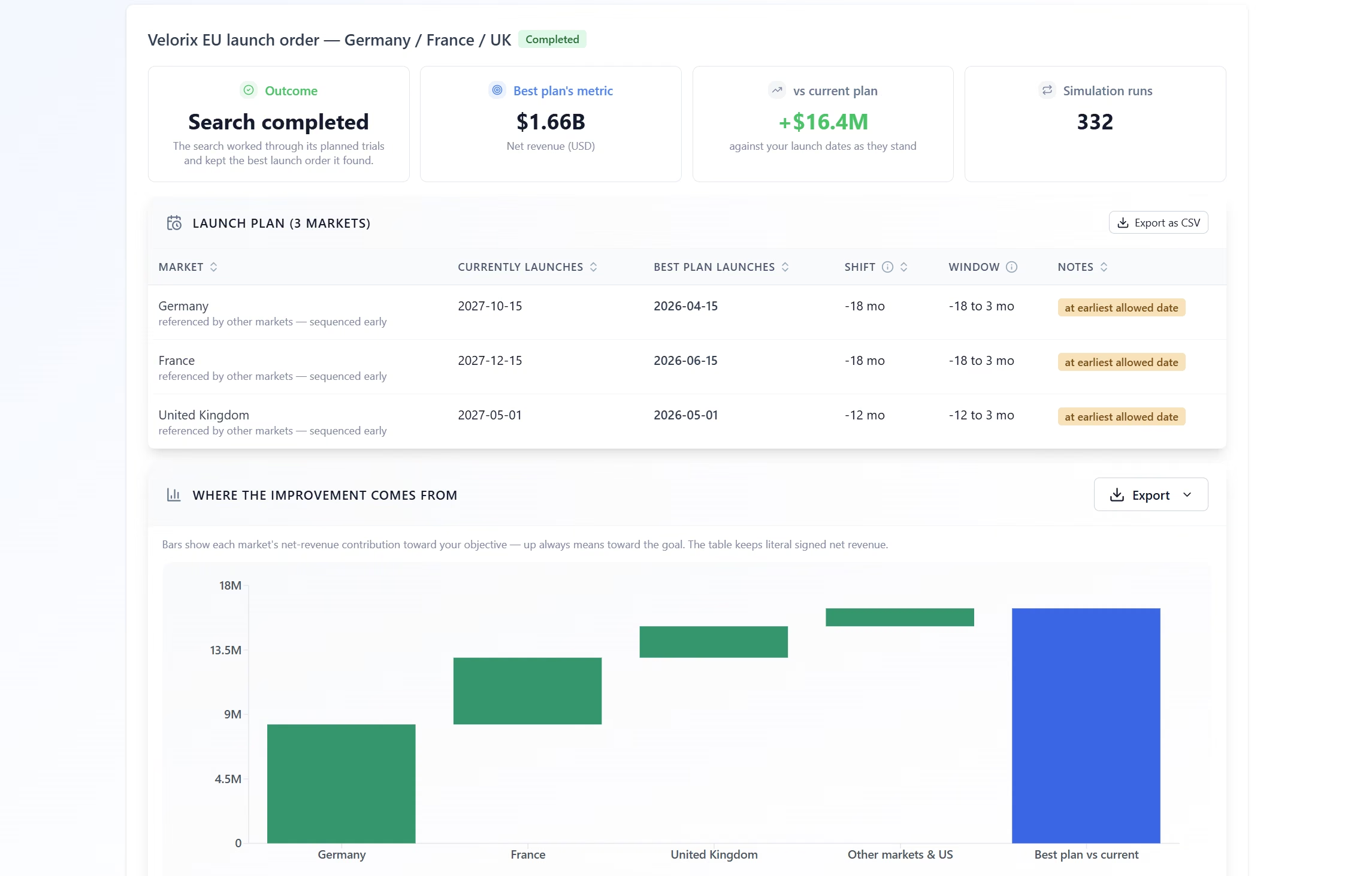
Optimizer Studio waterfall chart showing why a pharmaceutical pricing strategy wins, used in project analysis
Scenario search with its working shown: the waterfall breaks down why the winning strategy wins.

What you actually receive from a pricing project

A presentation, not a data dump

A PowerPoint deck written for the meeting it is going into, whether that is a pricing committee, a deal team or a board. Charts that make the argument rather than charts that show we did the work.

The strategic interpretation

What the numbers mean, which assumptions the conclusion depends on, where the risk sits, and what we would watch next. The reading of the analysis is the deliverable; the model is how we got there.

Native access to SyMAP

Log in and open the simulations yourself: the results, the event logs, every scenario we ran. Ask the AI assistant why a number moved. Nothing is locked in a file you cannot interrogate.

SyMAP results and AI summary, the view clients get native access to at the end of a project

The project does not end up in a drawer

The usual problem with commissioned analysis is that it ages badly. Plans change, a launch slips, a country cuts a price, and the work has to be bought again because it lived in a consultant’s workbook.

Because a project is built in SyMAP rather than for it, everything survives. If you licence the platform afterwards, the models are already there from day one: your markets configured, your products loaded, every scenario we ran saved and editable. You change an assumption and re-run it yourself.

That is why the two routes are a sequence rather than a choice. A project answers the question in front of you and, if it makes sense, leaves you standing in a working platform rather than holding a report.

What carries over

  • Country rules, reference baskets and referencing modes, already configured
  • Your portfolio and price points, already loaded
  • Every scenario from the project, saved and editable
  • The event logs and audit trail behind each result
  • Comparison views, so the next question starts from the last answer

The pricing questions we get asked

Projects tend to arrive as a decision with a date on it. Most are US Most Favored Nation questions, or questions where MFN turns out to be the binding constraint. These are the shapes they take most often.

What is our exposure to the US MFN models?
Your portfolio run through all four Most Favored Nation pathways: GENEROUS on Medicaid, GLOBE on Part B and GUARD on Part D, and the voluntary agreements. Product by product and channel by channel, against the benchmark each model actually applies (second-lowest PPP-adjusted for GENEROUS, the higher of Method I and Method II for GLOBE and GUARD), so you know what the mandatory models cost you before you decide anything else. Most projects start here.
Should we sign a voluntary MFN agreement?
The voluntary route reaches further than the mandatory models: into the commercial book, for every future launch. We model your blended net price across every US channel against the benchmark, put the sign and hold-out paths side by side, and add the Section 232 tariff position to both. The Art of the MFN Deal sets out the shape of that decision.
Which launch sequence protects the most value?
Launch order and timing across your markets, with the international reference pricing cascade modelled properly rather than assumed. Because international prices feed US MFN benchmarks, one sequence drives both your IRP erosion and your MFN exposure, which is why we model the two together rather than in two places.
What is our loss of exclusivity strategy?
Generic entry does not stay in one market. We model LoE across the portfolio: which reference markets fall first, how each cut cascades through the network and when, what it does to the MFN benchmark your US price is measured against, and which pricing or withdrawal decisions in the run-up actually change the outcome.
Does this asset’s pricing survive due diligence?
MFN and reference pricing exposure on an acquisition or licensing target, assessed fast enough to feed the deal timetable rather than confirm it afterwards. Run on the target’s own forecast assumptions, so the finding is hard to argue with.
Is this launch viable at the price the market will bear?
Corridor analysis against reference and policy constraints, with revenue and patient forecasting attached, so viability is a number rather than an opinion and the MFN consequence of the corridor is visible from the start.

Selected pricing analysis projects

MFN impact assessment

Pricing exposure on an acquisition target

The question. A mid-sized pharmaceutical company was assessing an acquisition and needed to know what US MFN policy would do to the target asset’s value, and whether its European launch plan was still viable, in time for the acquisition decision.

What we did. Built the target’s portfolio and markets in SyMAP and modelled its exposure across the MFN pathways, using the client’s own forecast assumptions rather than ours, then tested the European launch plan against reference pricing and policy constraints. Delivered in two weeks.

The outcome. A material MFN exposure, quantified on the client’s own numbers. That gave the deal team the tangible MFN risk attached to the purchase and what it did to projected revenue, early enough to inform the decision rather than explain it afterwards.

Global price forecasting

Optimised global launch for a US biotech

The question. A US biotech preparing to launch a rare disease asset needed a global price forecast, and a launch plan that would not quietly build US MFN exposure through the international prices it set on the way.

What we did. Modelled the reference network across 19 markets, forecast revenue over ten years, and used Optimizer Studio to search launch timing and market selection rather than testing a handful of sequences by hand.

The outcome. Optimising launch timing, and launching selectively rather than everywhere, significantly reduced the projected MFN impact. The recommendation changed both when the asset entered certain markets and whether it entered some of them at all.

SyMAP MFN results summary of the kind delivered in a Most Favored Nation impact assessment

Client names are withheld as standard. We are happy to talk through either engagement in more detail on a call.

Also available: AI training and toolkits

Analysis is the core of what we do. Two related things come up often enough to mention.

AI training for pricing teams

Practical, role-focused sessions rather than general AI literacy: what these tools are good and bad at in a pricing context, how to interrogate a model’s output instead of accepting it, and hands-on work in SyMAP IRP and SyMAP MFN. Run for teams who are adopting the platform or who simply want their analysts sharper.

Custom toolkits and data work

Where a workflow genuinely belongs in Excel, we build AI-assisted add-ins that sit inside it, and we can pull SyMAP results straight into your own reporting through the API. Pricing and market access data sourcing sits here too, since most projects need it before any modelling can start.

Pricing project FAQs

How long does a project take?
It depends on the breadth of the portfolio and the number of markets, and on how much of the input data already exists. Focused questions on a small basket move quickly; a full global forecast with an optimised launch sequence takes longer. We give a timescale when we scope, and we would rather turn work down than agree a date we cannot hold.
Do we get to keep the model?
You get native access to SyMAP to view and explore the simulations we built. If you then licence the platform, that work becomes yours to edit and re-run: same markets, same products, same saved scenarios, no rebuild.
Do we have to licence SyMAP to commission a project?
No. Projects stand on their own and many clients only ever want the answer. The platform is there if pricing questions turn out to be continuous rather than occasional.
Can you work with our existing data and assumptions?
Yes, and usually that is the fastest route. We can take your price files, forecasts and assumptions as the starting point, or source and build the reference data if you do not have it. Either way the inputs are visible in the model, so you can see exactly what the conclusion rests on.
How is this different from a pricing consultancy?
The analysis runs in a real product rather than a bespoke workbook. That means every reference price shows its formula, basket, matched products, FX rate and timing; the event log records each recalculation; and the work does not decay the moment the engagement ends. It also means you can carry on using it.
Can you review analysis we have already done?
Yes. Independent rebuilds are a common request, particularly where two internal models disagree or where an external number needs checking before it reaches a board. Because the calculations are inspectable, the discussion becomes about assumptions rather than about whose spreadsheet to trust.

Start with the question

Tell us the decision you are trying to make. If SyMAP is the wrong tool for it we will say so.