
GENEROUS: MFN Comes to Medicaid
How CMS is turning international reference pricing into guaranteed net prices for state drug programs
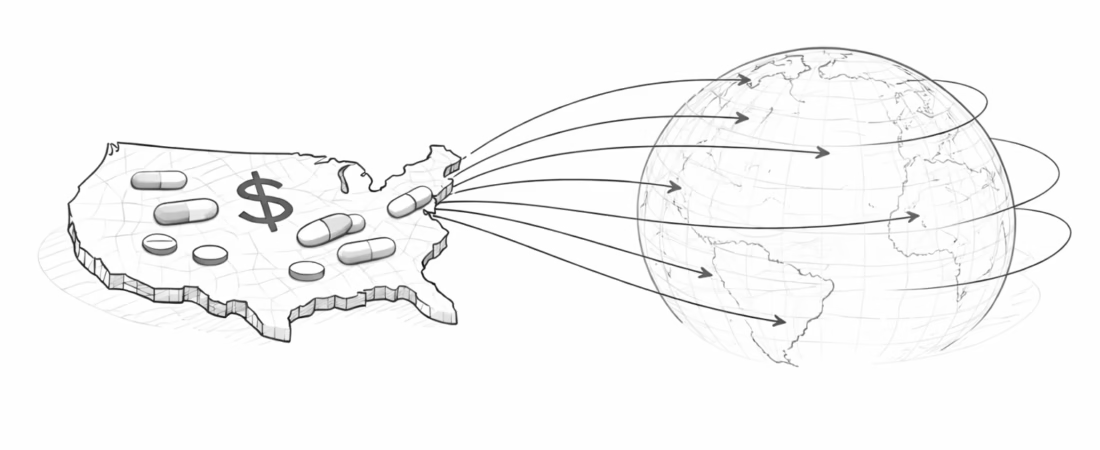
With GENEROUS, MFN stops being a slogan and becomes a tangible implementation of international reference pricing (IRP). Unveiled on 6 November 2025 by the CMS Innovation Center, this voluntary Medicaid model (2026–2030) bakes MFN logic into what states actually pay—net prices—using familiar levers: supplemental rebates and standardised coverage terms.
No statute rewrite, no Part B rerun—just an IRP benchmark turned into a guaranteed net and paired with uniform access. The rest of this piece unpacks how that works and where GENEROUS sits in the MFN push that’s gathered pace since Trump’s announcement.
Key Takeaways
- MFN via contract: GENEROUS uses supplemental rebates to deliver MFN-anchored net prices in Medicaid
- 8-country basket: UK, France, Germany, Italy, Canada, Japan, Denmark, Switzerland
- Timeline: Applications Nov 2025–Mar 2026; model runs 2026–2030
- Trade-off: Predictable access for manufacturers in exchange for MFN-tight nets
How GENEROUS sets the price
For each included drug, CMS calculates a Most-Favored-Nation (MFN) price from a fixed country basket using the average net price (last 12 months) and a GDP purchasing-power-parity (PPP) adjustment. The basket is:
France
Germany
Italy
Canada
Japan
Denmark
Switzerland
CMS then converts that benchmark into a Guaranteed Net Unit Price (GNUP) for Medicaid; the supplemental rebate due each quarter is:
Supplemental rebate = WAC – (GNUP + URA)So that a state’s net price lands at the MFN level, manufacturers must supply international net-price data at NDC-9 level, and CMS can audit. States that access a model drug at the MFN price agree not to seek extra supplemental rebates on that drug beyond the model terms (CMS).
Manufacturer applications run Nov 2025–Mar 31, 2026; participation agreements must be signed by Jun 30, 2026 (with rebates retroactive to Jan 1, 2026 for participating states). States receive their own RFA in Dec 2025 and must sign by Aug 31, 2026. The test ends Dec 31, 2030 (CMS may renew or modify).
Key Dates
- Nov 2025 – Mar 31, 2026: Manufacturer applications
- Jun 30, 2026: Participation agreements signed (rebates retroactive to Jan 1)
- Dec 2025: State RFA issued
- Aug 31, 2026: State sign-up deadline
- Dec 31, 2030: Model ends (CMS may renew or modify)
Why this MFN design matters
GENEROUS differs from the 2020 Medicare Part B MFN rule that courts blocked and CMS formally rescinded in 2021. That earlier attempt tried to mandate foreign-linked payments in Medicare; GENEROUS uses contracts in Medicaid to deliver MFN-anchored net prices—a legally sturdier path that mirrors how states already run supplemental rebates.
Its reference-pricing spine is also more realistic than classic list-price IRP:
Dampening currency and list-price noise
UK, France, Germany, Italy, Canada, Japan, Denmark, Switzerland
Clear data-to-GNUP process states can invoice against
For manufacturers, that makes the target clearer; for states, it promises MFN-level nets without bespoke deal-making on every brand.
Where GENEROUS sits in today’s MFN landscape
This year’s policy arc began with a May 2025 Executive Order reviving “most-favored-nation” goals—explicitly aiming to align U.S. drug prices with high-income peers. The White House has since highlighted deal-making alongside models, including high-profile agreements on GLP-1 medicines with Eli Lilly and Novo Nordisk that set government and cash-pay prices dramatically lower than today’s list prices.
These deals aren’t part of GENEROUS, but they push the same goal: shrink the gap between U.S. and other countries’ drug prices using both voluntary deals and formal programs.
Against that backdrop, GENEROUS is Medicaid’s structured path to MFN: one fixed country basket, a clear way to set the benchmark, standardised coverage terms, and simple quarterly rebates to land on the target net price.
It sits alongside—rather than replacing—the IRA’s Medicare negotiation (which doesn’t use international reference prices), so drugmakers are now dealing with multiple parallel systems: IRA in Medicare, optional MFN-anchored net pricing in Medicaid via GENEROUS, and the proposed GLOBE and GUARD models bringing MFN to Medicare Part B and Part D.
Implications to plan for
For Manufacturers
The trade-off is straightforward: predictable access under standardized terms in exchange for MFN-tight Medicaid nets. Joining requires:
- Robust global net-price data (NDC-9)
- Comfort with audit
- Careful modeling of GNUP vs. today’s Medicaid nets
- Assessment of spillovers to commercial and ex-U.S. strategies
For States
The value proposition is MFN-aligned nets without serial bilateral negotiations, at the cost of:
- Adopting common coverage terms on model drugs
- Forgoing extra supplemental rebates where the MFN price is used
Early-adopter choices will shape norms on access and savings.
The bottom line
GENEROUS can be seen as a pragmatic MFN implementation. It keeps international reference pricing out of statute but firmly in play via contract, pairing MFN-anchored nets with uniform access.
For pharma, this is now a live 2026 planning item: decide where participation makes sense, build the data plumbing, stress-test global pricing, and be ready to engage states that opt in.
Model GENEROUS scenarios with SyMAP
SyMAP GENEROUS helps pharmaceutical pricing teams simulate MFN benchmarks, calculate supplemental rebates, and assess portfolio-level GENEROUS impact.